
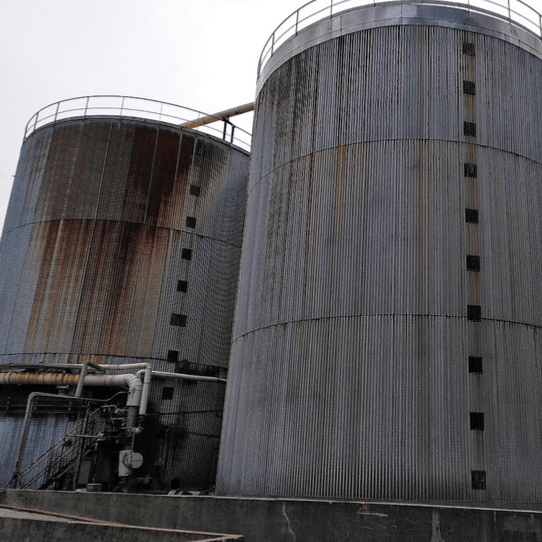
Some storage tanks are exposed to degradation that can weaken them and lead to accidents. Tanks storing hazardous products are subject to regulatory inspections, as set out in the decrees of October 4 and 5, 2010. This Industrial Facilities Modernization Plan (PM2I) covers asset identification, initial condition assessment, and the inspection plan to be carried out.
Insulated tanks are more difficult to inspect because the areas of interest are located beneath the insulation, out of reach for inspectors.
Customer challenges
Insulation promotes water retention zones through runoff or condensation, which encourages localized corrosion. These areas are difficult to monitor because they are inaccessible to inspectors.
To limit costs, operators and inspectors define measurement windows where they can perform spot thickness measurements.
The problem with conventional methods
These solutions themselves generate work at height through scaffolding, mobile elevated work platforms, or rope access technicians. They may also raise legal compliance issues, such as the use of rope access technicians when safer alternatives exist (French Labour Code R4323-64).
From a cost perspective, building scaffolding is almost always more expensive than the inspection itself.
In addition, these spot measurements, although compliant with the DT94 guideline, lack representativeness — a limitation that cannot be offset by a simple visual inspection of the shell.
Solution: UT_Pole + Altiscan
A maintenance manager from a paper mill site contacted us. He wanted to carry out the internal inspection of an insulated tank 11.5 m in diameter and 14 m high, without mobilizing access equipment.
For this industrial operator, we deployed the UT_Pole pole and the Altiscan robot to perform continuous ultrasonic thickness measurement (B-scan).
Complete B-scan report. The delivered report gives the client a clear thickness profile of the shell courses. Thousands of points are summarized and ready to be used for engineering calculations and to prepare any future maintenance operations.
SONIC prototype tested on site. The internal shell surface had severe roughness and layered corrosion. We were able to test SONIC, our surface-cleaning prototype, which significantly improved the results of continuous thickness measurements.
Results
Our client saved several hours on site, simplified intervention management, and benefited from a much more detailed report thanks to the B-scan.
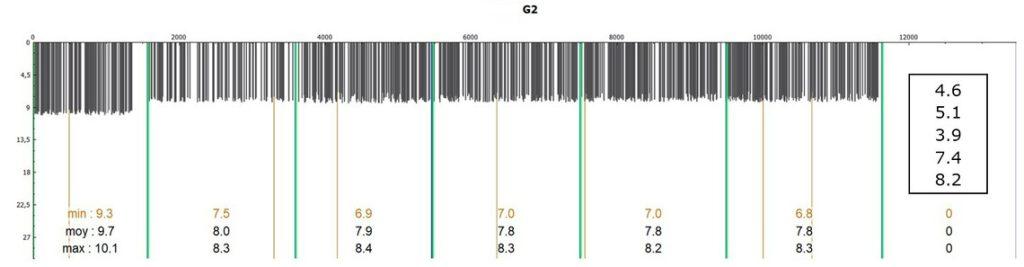
B-scan report — internal inspection of a 14 m insulated tank.
Half a day, zero scaffolding, one complete B-scan report — UT_Pole and Altiscan secure the internal inspection of insulated tanks.
Need to inspect an insulated tank?
Contact our team for a demonstration or a feasibility study. Reply within 24 hours.