
SubCscan, fire water tank floor inspection without draining
Roboplanet inspects fire water tank floors in service, with no draining and no human entry: automated ultrasonic thickness acquisition, from a single probe to phased array C-scan, ROV visual inspection of 100% of the floor, and sediment and residue management.
Fire water stays available
No draining: the tank stays in service throughout the inspection.
Nobody enters the tank
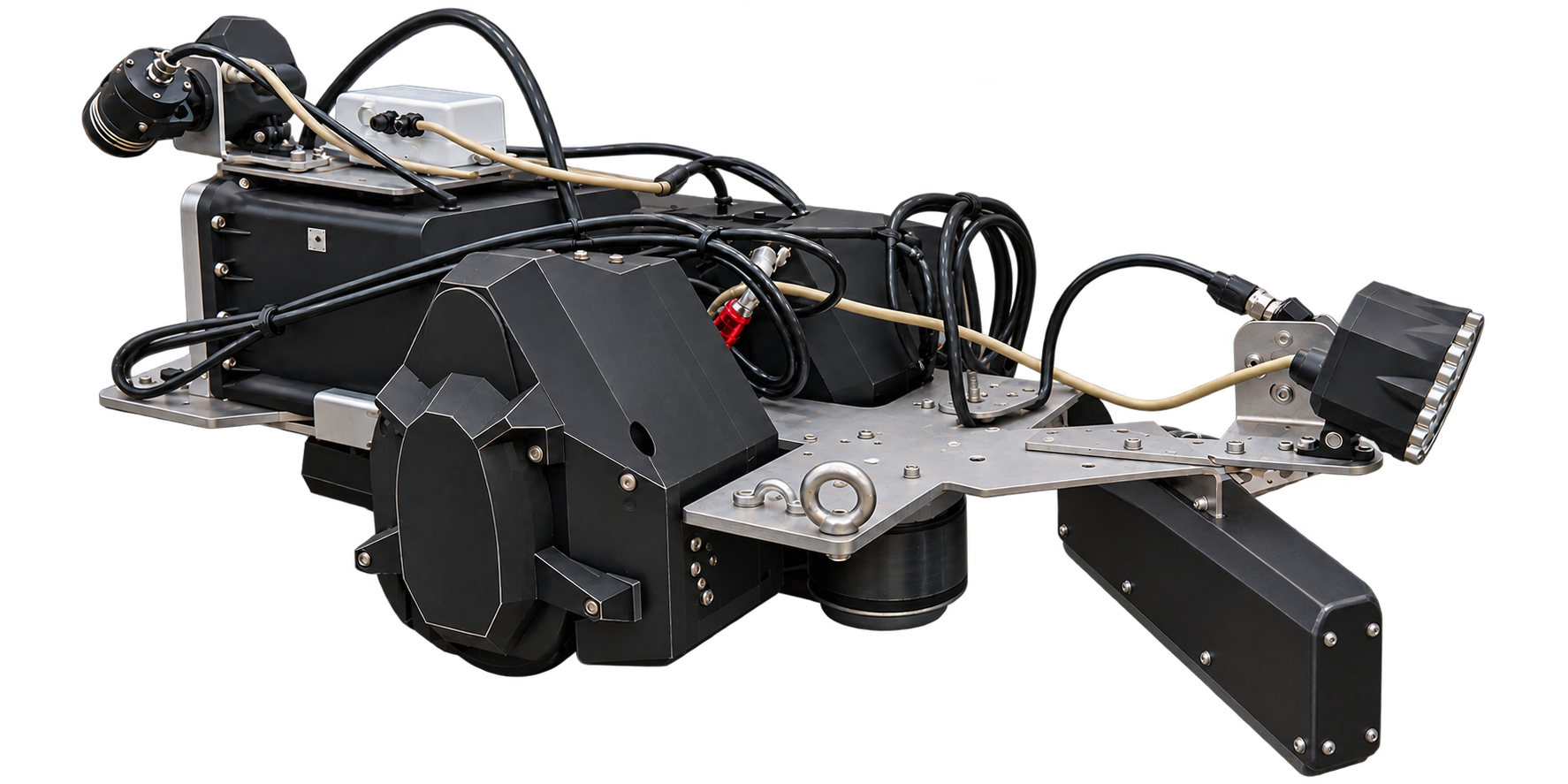
Robot and umbilical (25 kg) deployed from the tank roof. No divers, no confined space entry.
Measurements you can compare over time
Automated acquisition, each measurement located to ± 50 mm and comparable from one campaign to the next.
Designed for fire water tanks
Fire water tanks are often left out of tank inspection plans: they “only store water”. Yet the site’s fire protection depends on them, and floor corrosion on the soil side cannot be seen from the outside.
IP68 immersion down to 20 m
Immersed crawler lowered from the tank roof by davit or scaffolding, through a 500 mm manhole. Robot and umbilical: 25 kg.
Three measurement levels
Single probe for B-scan lines, multi-probe for 100% covered strips, phased array C-scan for area mapping. Can be combined on the same job.
Even through paint
5 MHz, Ø 13 mm ultrasonic probe. Measures through up to 0.6 mm of paint, one reading every 20 mm along lines and every 5 mm at the shell-to-floor junction.
Brushing and sonar
Brush clearing up to 5 mm of sediment to ensure UT contact. Optional sonar for navigation and sediment mapping.
ROV visual of 100% of the floor
An ROV inspects the floor, nozzles, drain sump and coating condition. Photo report included.
Actionable reports
Field report at the end of the job, final report within 10 working days: thickness mapping, B-scan or C-scan, photo report and areas not inspected.

Your fire water reserve stays available
Inspecting a tank floor usually means draining the tank and leaving the site without its fire water reserve. SubCscan works with the tank full: no pumping out or refilling thousands of m³, no discharged water to handle, no compensatory measures during the inspection.

Located thickness data you can compare over time
Acquisition is automated, with electronic sensors and dedicated software, and no manual readings. From one campaign to the next, you track the corrosion rate and base your decisions on measurements: out-of-service inspection, repair or postponement.
Immersed inspection, tank in service
Deployment from the tank roof, sediment brushing, ultrasonic measurement and ROV visual inspection of the floor.
Adapt the job to your site
Complete the configuration according to your inspection, navigation and cleaning needs.
Umbilical length
Umbilical configuration according to tank geometry and intervention distance.
ATEX certification
Possible adaptation to regulated area constraints depending on the operating context.
Sonar module
Sediment mapping and immersed navigation assistance.
Sediment removal
Removal of up to 400 mm of sediment with a partner, with residue management adapted to the operator’s requirements and local regulations.
Maintenance & spare parts
Field support, available spare parts and maintenance for long inspection campaigns.
Datareport & UT acquisition
Automatic report generation and wireless UT acquisition on a rugged field PC.
Datasheet
Inspected surface
Carrier
Sediment management
On-site job
Ultrasonic measurements
Power supply
Signal processing
Operating conditions
Inspecting a fire water tank in service
Does a fire water tank need to be inspected?
Yes. The site’s fire protection depends on it. In the United States, NFPA 25 provides for an internal inspection every 5 years, or every 3 years for steel tanks without corrosion protection. In France, fire water tanks fall outside the regulatory inspection plans for flammable liquid tanks, but a prefectoral order or the site’s hazard study may still require monitoring.
Can a fire water tank be inspected without draining it?
Yes. From the tank roof, Roboplanet deploys the SubCscan crawler, which measures floor thickness by ultrasound, and an ROV for visual inspection. The tank stays in service and available for fire protection.
How do you measure tank floor thickness while the tank is in service?
With ultrasound, using a robot that moves across the floor. Roboplanet offers three levels: a single probe for B-scan lines, multiple probes for 100% covered strips, or phased array C-scan for area mapping.
Can measurements be compared from one inspection to the next?
Yes. Acquisition is automated, with electronic sensors and dedicated software, and each measurement is located to ± 50 mm.
Does a painted floor prevent measurement?
No, up to 0.6 mm of paint: the measurement is taken through the coating.
How is this different from an ROV inspection?
An ROV provides visuals. Roboplanet adds ultrasonic floor thickness measurement with the tank full: the operator gets mapped thicknesses, not just images.
Can the robot work near an active fire water suction?
Yes, with a 1 m exclusion zone around the suction, backed by hydraulic calculation. When the pump start alarm sounds, the robot is immobilized.
What if the floor is covered with sediment?
Roboplanet and its partner remove up to 400 mm of sediment and manage residues according to the operator’s requirements and local regulations.
Does in-service inspection replace out-of-service inspection?
No. It provides measured data to decide on an out-of-service inspection, a repair or a postponement.
What does the report include?
A field report at the end of the job, then, within 10 working days, a thickness map, B-scans or a C-scan, a photo report and the areas not inspected.
Your next inspection can be done with the tank full
Tell us the tank diameter, water height, manhole size, estimated sediment height, whether the floor is painted and whether the fire water suction stays active. We will get back to you with a feasibility study.