
Geometric Inspection of Storage Tanks
Regulations, 3D Inspection, and Compliance
Storage tanks are among the most sensitive installations on an industrial site. To ensure their integrity, safe operation, and regulatory compliance, they are subject to periodic Non-Destructive Testing (NDT).
Among these NDT methods, geometric and visual inspections are essential for assessing the stability of the tank and detecting any potential deformations.
A Regulatory Inspection at the Heart of Tank Maintenance
Storage tanks contain hazardous or polluting liquid products and are therefore subject to strict regulations.
Their periodic inspection is part of the requirements defined by the following codes and technical guidelines:
- CODRES – French Construction and Repair Code for Storage Tanks
- API 653 – American Petroleum Institute (Inspection, Repair, Alteration, and Reconstruction of Steel Tanks)
- EEMUA 159 – European Mechanical Users Association, a reference guide recognized at the European level
- PM2I / DT94 / Copacel Guide – French technical guides derived from the decrees of October 3 and 4 concerning ICPE facilities, revised and adapted to industrial specificities
These standards define the mandatory Non-Destructive Tests (NDT) to be performed on storage tanks, including geometric inspection, visual inspection, and dimensional checks of structural integrity.
Inspections Carried Out During a Regulatory Assessment
A comprehensive tank inspection combines several types of Non-Destructive Testing (NDT):
- Geometric inspection: measurement of the tank’s verticality, flatness, and roundness.
- Visual inspection: detailed examination of the tank shell, bottom, welds, and accessories (nozzles, anchors, rings).
- Ultrasonic thickness measurements: used to assess material loss.
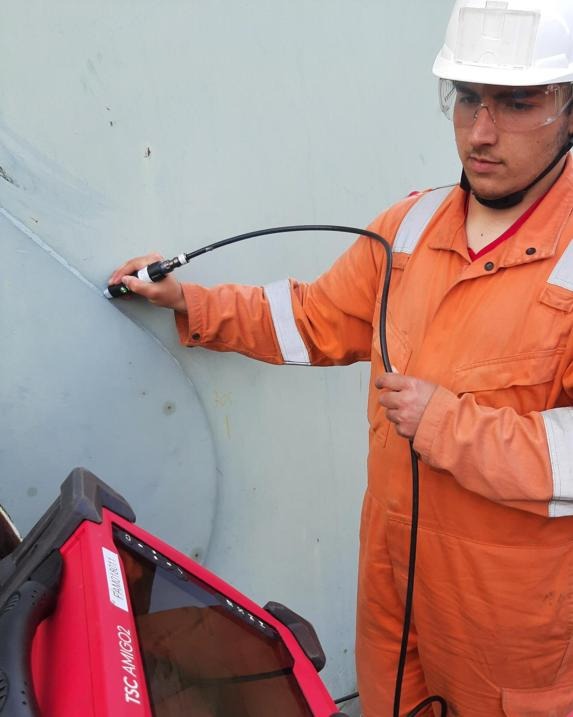
- Crack detection: particularly using the ACFM method (Alternating Current Field Measurement).
All these operations help determine the tank’s remaining service life and ensure its regulatory compliance according to the CODRES, API 653, EEMUA 159, and PM2I / DT94 / Copacel Guide standards.
The Limitations of Traditional Methods: Plumb Line and Theodolite
Historically, geometric inspections were carried out using a plumb line, an optical level, or a theodolite.
Although these instruments long served as reference tools, they now present several limitations:
- Point-based measurements that cover only part of the tank.
- Operator dependence, which can lead to interpretation discrepancies.
- Lengthy inspection times, requiring multiple repositionings.
- Lack of digital modeling, preventing long-term comparison of results.
These limitations reduce the overall understanding of the tank’s actual geometry and the reproducibility of measurements.
The Contribution of 3D Laser Scanning to Geometric Inspection
3D laser scanning has profoundly transformed the geometric inspection of storage tanks.
This technology provides a complete mapping of the tank, enabling visualization of both global and local deformations in three dimensions.
Advantages of 3D inspection:
- Full 3D modeling of the tank
- Comprehensive mapping of deformations (verticality, flatness, ovality)
- Time savings during on-site operations
- Digital archiving and comparison over successive inspection campaigns
3D scanning has become a modern tool for integrity monitoring and preventive maintenance for industrial operators.
ROBOPLANET: Expertise and Regulatory Compliance
ROBOPLANET deploys the ALTISCAN and UT_Pole systems for the geometric and dimensional inspection of storage tanks.
These technologies enable comprehensive inspections while fully complying with the requirements of CODRES, API 653, EEMUA 159, and PM2I / DT94 / Copacel Guide standards.
Our Services Ensure:
- High metrological reliability and measurement reproducibility
- Reduced inspection time
Full compliance with applicable codes and standards
Geometric inspection is a key step in the regulatory Non-Destructive Testing (NDT) of storage tanks.
When combined with rigorous visual inspection, ultrasonic thickness measurements, and ACFM crack detection, it provides a comprehensive and reliable assessment of the tank’s structural condition.
Thanks to its innovative inspection systems and technical expertise, ROBOPLANET supports operators in risk prevention, HSE safety, and the long-term reliability of their installations.
 Contact us for your inspection and regulatory compliance needs.
 To learn more, visit our page on weld inspections.