
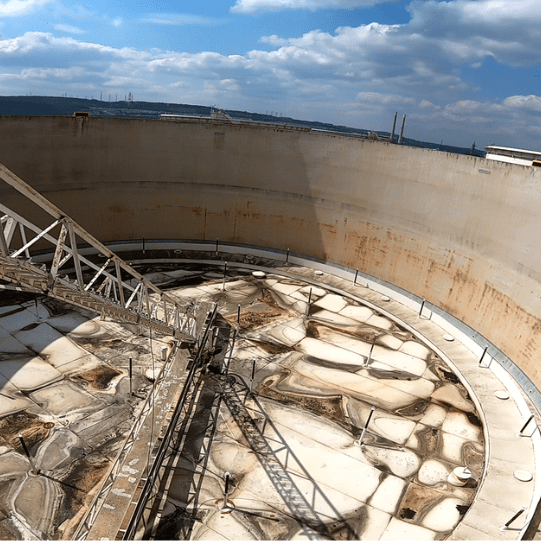
Inspecting floating roofs on active storage tanks involves various risks: structural failure, roof tilting, or roof perforation. These roofs must be subject to regular monitoring to prevent such risks. Tanks storing hazardous products are subject to regulatory inspections set out in the decrees of October 4 and 5, 2010. This Industrial Facilities Modernization Plan (PM2I) covers asset identification, initial condition assessment, and the inspection plan to be carried out.
Customer challenges
The most common degradation mode is loss of thickness from the inside. This phenomenon appears particularly in the vapor space and is accelerated by the acidity, temperature, or density of the stored product. To quantify this wall loss, thickness measurements are taken on the roof.
Since the inspection areas are sometimes degraded by foam, dirt, or other deposits, measurements may require preliminary cleaning.
A combination of critical risks
Work in this area combines ATEX risks and confined space risks, making it complex to manage from both operational and regulatory perspectives.
Solution: the UT_Rover robot
A maintenance manager from an oil site contacted us. He wanted to inspect floating roofs while minimizing operator intervention in this high-risk area.
For this industrial client, we deployed the UT_Rover robot. Equipped with wheels and magnets, it moves across the roofs and carries:
- A brushing head to clean the inspection surface and ensure reliable measurements
- A thickness measurement chain — 1 measurement per centimeter, with digitized signal that can be analyzed afterward
Continuous B-scan. The delivered report gives the client a clear thickness profile of the tank roof. Thousands of points are summarized and ready to be used to prepare any future maintenance operations.
On this project, the dedicated design of the UT_Rover made it possible to intervene within a very short timeframe, without exposing operators to hazardous areas.
Results
Our client avoided work at height and benefited from a much more detailed report thanks to continuous B-scan, all under optimal safety conditions, with no operator exposed on the roof.
No ATEX exposure for operators, no confined space entry, and a complete B-scan report — UT_Rover secures the inspection of active floating roofs.
Need to inspect a floating roof?
Contact our team for a demonstration or a feasibility study. Reply within 24 hours.