
Some storage tanks are exposed to degradation that can weaken them and lead to accidents. Those storing hazardous products are subject to regulatory inspections, as set out in the decrees of October 4 and 5, 2010. This Industrial Facilities Modernization Plan (PM2I) covers inventory, initial condition assessment, and the inspection plan to be carried out.
Customer challenges
The most common degradation mode is loss of thickness from the inside. This phenomenon appears particularly in the vapor space and is accelerated by the acidity, temperature, or density of the stored product.
To quantify this wall loss, thickness measurements are performed on the shell. These are work-at-height operations, which generate specific risks and therefore require access equipment such as scaffolding, mobile elevated work platforms, or rope access technicians.
The problem with conventional methods
These solutions themselves create work-at-height situations. They may also raise legal compliance issues, such as the use of rope access technicians when safer alternatives exist (French Labour Code R4323-64).
From a cost perspective, building scaffolding is almost always more expensive than the inspection itself.
Solution: the UT_Pole
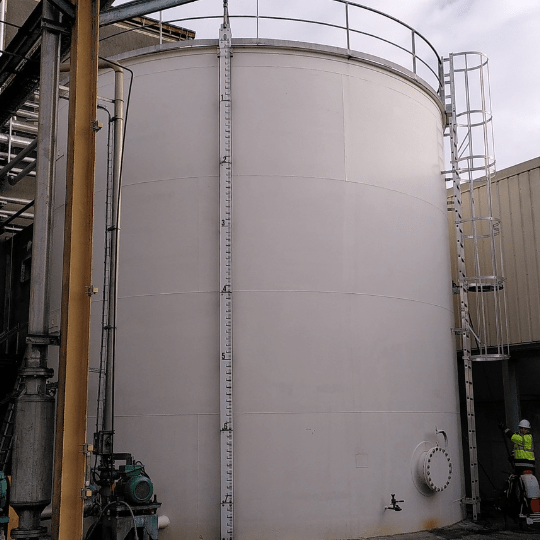
A maintenance manager from a sugar production site contacted us. He wanted to inspect the shell of an 8 m high storage tank without mobilizing any access equipment.
We deployed the UT_Pole. It is a rolling carrier equipped with magnets that make it possible to inspect steel walls. This carrier carries a thickness measurement chain: 1 measurement per centimeter, with a digitized signal that can be analyzed afterward.
Deployment up to 12 m high thanks to a telescopic pole. The operator remains on the ground and has every chance of identifying ring corrosion and, to a lesser extent, area corrosion.
The delivered B-scan report gives the client a clear thickness profile of the shell courses. Thousands of points are summarized and ready to be used for engineering calculations and to prepare any future maintenance operations.
Fast intervention with minimal footprint. On this project, the dedicated design of the UT_Pole made it possible to intervene very quickly with very little footprint — ideal for small tanks where the space around the structure is limited.
Results
Our client saved several hours on site, simplified intervention management, and benefited from a much more detailed report thanks to the B-scan.
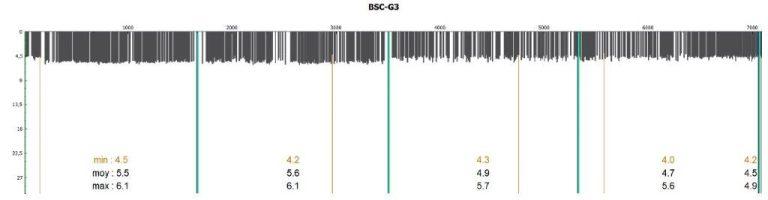
B-scan of a vertical scan line on the shell of a small 8 m high tank.
2 hours, zero scaffolding, one complete B-scan report — UT_Pole makes small tank inspection simple, safe, and cost-effective.
A tank to inspect?
Contact our team for a demonstration or a feasibility study. Reply within 24 hours.