
As part of a national call for projects in aerospace maintenance, our team was asked to design an innovative solution to automate the periodic inspections carried out on fighter aircraft wings.
These inspections, which are critical to flight safety, are intended to detect the early appearance of cracks in specific structural areas subjected to high mechanical stress. Today, these inspections are still performed manually by highly specialized operators, using methods that are robust, but still highly labor-intensive.
The current process
Manual marking of the inspection areas on the component, followed by calibration, positioning and acquisition steps using Phased Array ultrasonic probes, then manual interpretation of the collected data.
These operations are time-consuming, physically demanding (awkward postures beneath the aircraft), and rely on a limited number of heavily solicited experts.
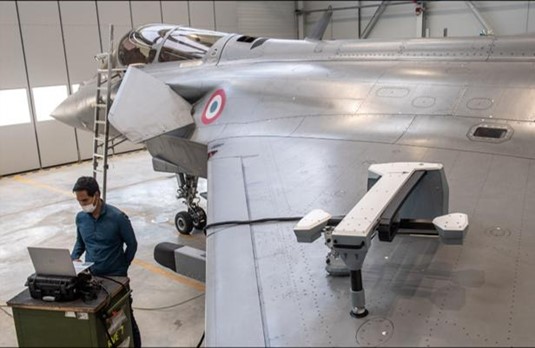
Objective
Develop an automated, portable and reliable solution capable of:
- Reducing operator strain
- Automating the acquisition of ultrasonic data on specific areas
- Improving the repeatability and traceability of inspections
- Reducing the time required for data analysis and interpretation
- Reaching TRL6 maturity within a short timeframe
Developed solution
We designed a portable, intelligent and autonomous system, manually positioned by the operator on each area to be inspected. Once in place, the system fully handles:
Localization
Automatic detection of the area to be inspected
Movement
Precise positioning of the Phased Array probe
Acquisition
According to standardized procedures, with preconfigured calibration
Recording
Structured data, amplitude mapping and time-of-flight mapping
Intuitive human-machine interface. The operator simply launches the acquisition. The interface includes interpretation support tools with automatic sizing of non-conformities, as well as structured post-processing to accelerate analysis.
Methodological approach
The project was carried out using an agile approach: short cycles with frequent prototype deliveries, regular testing in real-life conditions, and continuous co-design with field operators to integrate their operational constraints from the very first design stages.
Results
The solution has gained strong operator acceptance, with operators now valued more for their analytical role than for manual handling, while ensuring full repeatability and traceability of inspections.
Feedback & outlook
This project marked our first immersion in the field of composites and ultrasonic NDT. In one year, we discovered the technical and human constraints of this sector, and learned to master probes, defectology and the working environment.
Technology building blocks identified
Clear visibility on the missing components required to cover the remaining 20% of areas.
100% coverage planned
A roadmap has been defined to extend the solution to all surfaces to be inspected.
Automated analysis
Improvement paths identified for post-processing and automated data analysis.
From prototype to TRL7 in less than one year — ROBOPLANET demonstrates that inspection robotics can also adapt to the most demanding environments in aerospace.
A custom inspection project?
Our engineering office designs solutions tailored to your constraints. From feasibility to operational deployment.